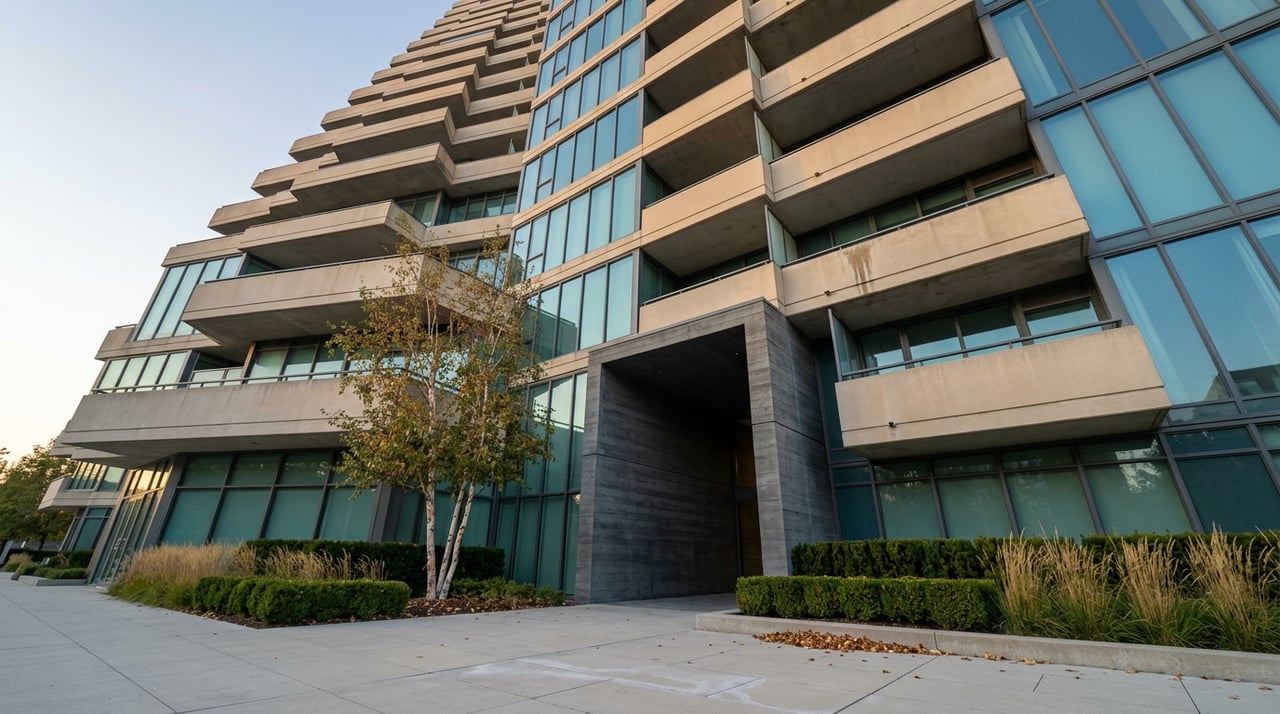
For most of the last decade, the lot at 23 S. Sangamon Street sat empty across from Mary Bartelme Park, waiting for someone to decide what it wanted to be. A developer bought it in 2013 and never broke ground. Another tried for a 24-story apartment tower in 2018 and got nowhere. For three years, a West Loop resident named Moshe Tamssot ran a temporary community garden on the site, which is about as clear a signal as a neighborhood can send that nobody quite knew what to do with the block.
That indecision finally ended this year. The site has a name now: Marielle on the Park, a 24-story tower with 70 condos, most of them three and four bedrooms, priced at market rate. What the project gave up to get there tells you more about who's actually buying in the West Loop right now than anything you'll find on a listing sheet.
Five Years, Four Plans, One Direction
Watch what happened to this parcel since 2021 and a pattern shows up that has nothing to do with one developer's indecision and everything to do with what the market will actually support.
The first approved version, back in 2021, was an 80-unit, 19-story condo tower with two, three, and four-bedroom layouts averaging around 2,200 square feet. The developers were targeting $600 to $700 per square foot, putting the average unit near $1.3 million. Groundbreaking was supposed to happen by early 2022. It didn't.
By 2024, the plan had flipped entirely. Fern Hill and Free Market Ventures came back with a 283-unit, 33-story rental building, complete with a 30,000-square-foot community center and an outdoor field house with basketball, tennis, and pickleball courts, fully funded and staffed by the developer for the neighborhood. A version of that plan floated in early 2025 kept a condo component too, 63 units on the top floors, four and five bedrooms, priced at $900 to $1,000 per square foot, stacked above 130 rental apartments below.
Then, in April 2026, the community center and field house disappeared. Block Club Chicago reported the revised proposal: a 70-unit condo building, majority three and four bedrooms, market rate, with four public bathrooms and a storage room for the park replacing what had been a 30,000-square-foot civic amenity.
By August, the plan tightened again. Chicago YIMBY reported the tower had shrunk to 24 stories from 33, the field house was cut entirely after neighbors raised concerns about added wear on the park, and all 70 units are now condominiums. No rentals. A small corner cafe and restaurant space now flank the lobby. There will be no affordable units built on-site. Instead, the developer is partnering with Pilsen Housing Cooperative to build them off-site. The project still needs full zoning approval, and no groundbreaking date has been set.
Look at the shape of that arc. Every revision moved in the same direction: fewer total units, more bedrooms per unit, less shared civic space, and a harder commitment to condos over rentals. Nobody at Fern Hill sat down five years ago and planned to end up here. The market kept telling them where the money was, and they kept following it.
The Bedroom Count Isn't a West Loop Story
It's tempting to read Marielle on the Park as a one-off, a single developer chasing a single site's economics. It isn't. It's a symptom of something happening across the entire city.
An analysis of local MLS data found that as of the first quarter of 2026, roughly 80 percent of Chicago's current new-construction condo inventory has three or more bedrooms, and 26 percent has at least four. Back in 2008, four-bedroom new-construction units made up just 3 percent of what was on the market. That's not a gradual drift. That's a market that has almost entirely stopped building small.
Part of why is scarcity itself. In January 2008, at the peak of pre-crash new-construction supply, there were roughly 3,100 new-construction condos and townhouses for sale citywide. By March 2026, there were just 101. The average sale price on that shrinking pool climbed from about $369,000 in the first quarter of 2008 to roughly $899,000 as of April 2026. What little the city is building now sits almost exclusively at the top of the market, sized for families rather than the studio-and-one-bedroom buyer who used to define downtown Chicago condo living.
Marielle on the Park's 70 units, overwhelmingly three and four bedrooms, isn't an unusual bet. It's the current default for what actually gets built when a developer decides to build at all.
The Real Comparison Isn't West Loop vs. River North
If you're shopping for space downtown, the neighborhood comparison you've probably been running in your head is West Loop condo versus River North condo, or maybe West Loop versus South Loop. That's the wrong matchup. The comparison that actually matters right now is West Loop condo versus Lincoln Park single-family home, because that's the trade a lot of family buyers are quietly making.
Lincoln Park's single-family market has become genuinely difficult to enter. The median sale price for a single-family home there reached $2.46 million in March 2026, a sharp jump from the year before, and inventory sat near historic lows with only about 28 houses on the market in a neighborhood of roughly 70,000 residents. When the classic answer to "where do families buy space in Chicago" prices out that fast, the demand doesn't disappear. It goes looking for a substitute.
That's exactly the gap a project like Marielle on the Park is built to fill. Mary Bartelme Park sits right across the street. Skinner West Elementary's attendance boundary already draws families to the surrounding blocks. A Mariano's and a growing roster of family-oriented businesses have made the area a viable long-term home rather than a layover before the suburbs. The ingredients that made Lincoln Park the default family neighborhood are increasingly available a few blocks from Fulton Market, just packaged as a condo instead of a house.
The Building Stock Already Told Us This Was Coming
West Loop's original housing stock wasn't built with families in mind. The timber lofts along Randolph, Adams, and Washington were built for character, exposed brick, tall factory windows, open floor plans, generally sized for a single buyer or a couple who valued square footage less than the industrial aesthetic.
The shift toward larger family units isn't new to Marielle on the Park either. Embry, the full-amenity tower at 21 N. May that delivered a few years ago, already offered two, three, and four-bedroom layouts alongside duplexes and half-floor penthouses, built for buyers who wanted room to grow. Within a few blocks of the Sangamon site itself, buildings like Illume on Peoria and Lofthaus on Sangamon add to a cluster of newer product aimed at the same buyer. Marielle on the Park isn't introducing a new appetite to the neighborhood. It's accelerating one that was already there.
A Win for the Community, According to Whom
Alderman Bill Conway, who now represents the site after a ward remapping shifted it from the 25th Ward to the 34th, has praised the revised plan as a win for both the developer and neighbors who use the park. His more specific claim is worth taking at face value rather than dismissing as spin: "They're going to be one of the very few buildings in that area that has units of this size."
Not every West Loop resident agrees the trade was worth it. Losing a fully funded 30,000-square-foot community center and field house in exchange for four public restrooms is a real downgrade in civic amenity, and it's fair for neighbors to be frustrated by that. But Conway's point about unit size holds up. Three and four-bedroom condos at this scale genuinely are rare in the immediate area, and that rarity is exactly what makes the project worth watching if you're house hunting with a family in mind.
What This Means If You're Comparing Neighborhoods Right Now
If you need three or more bedrooms and want to stay downtown, don't assume West Loop can't compete with Lincoln Park on space. It increasingly can, and buildings like Marielle on the Park are being built specifically for that comparison. Just know the timeline risk is real. This exact site has been redesigned four times since 2021 and still doesn't have full zoning approval or a groundbreaking date, so treat renderings as a preview, not inventory.
If you're looking for something smaller, a one or two-bedroom unit for yourself or as an investment, understand that fewer of those are being built each year across the city. The existing loft stock along Randolph, Adams, and Washington may serve you better than waiting on new construction, since new construction is chasing the opposite end of the market entirely.
And if you're weighing West Loop against Lincoln Park for a family purchase, run the numbers on both paths before assuming the house is the only answer. The math has shifted enough that it isn't anymore.
If you want a read on which West Loop buildings actually deliver family-scale space today, and which pre-construction projects are worth watching versus waiting on, Luke Sandler tracks this market block by block. Reach out to receive exclusive listings before they hit the broader market.